Delhi’s Yamuna still polluted despite upstream improvement
Yamuna shows signs of recovery outside Delhi, but city stretch remains toxic
As thousands of devotees gather along the Yamuna river in Delhi to celebrate Chhath Puja, the holy river once again becomes the center of both faith and political debate. While some parts of the river show improvement, large stretches inside the city continue to be dangerously polluted, raising questions about the effectiveness of the government’s clean-up drives.
Water cleaner near entry points, but toxic within city
According to recent data from the Delhi Pollution Control Committee (DPCC), the Yamuna’s condition changes drastically as it flows through the capital. At Palla, where the river enters Delhi, the biochemical oxygen demand (BOD) level — a key indicator of organic pollution — was recorded at 2.5 milligrams per litre (mg/L). The safe limit for bathing or ritual use is 3 mg/L. At nearby Wazirabad, the reading was exactly at the safe mark of 3 mg/L.
However, the water quality drops sharply as the river moves downstream. The BOD levels were measured at 22 mg/L near ISBT, 20 mg/L at the ITO Bridge, 23 mg/L near Nizamuddin, and 21 mg/L at Okhla. These figures show that the Yamuna becomes highly polluted within the city limits. Experts say such high levels mean the water is unfit for bathing or any religious rituals, posing health risks to those who use it during Chhath Puja.
Officials admit that despite pre-festival cleaning efforts, industrial waste, untreated sewage, and urban runoff continue to flow into the river. Several drains discharge polluted water directly into the Yamuna, especially between Wazirabad and Okhla — the most critical stretch known as the “sewage belt.”
Even with visible surface cleaning and the removal of floating waste before Chhath, the underlying water quality has not shown major improvement. Environmentalists say the pollution is “deep-rooted” and cannot be fixed through short-term clean-up drives conducted before festivals.
Politics over pollution continues
The Yamuna’s pollution problem has long been a political flashpoint between the Aam Aadmi Party (AAP) government in Delhi and the Bharatiya Janata Party (BJP), which controls the municipal bodies and the central government agencies handling the river.
Delhi Chief Minister Rekha Gupta praised her government’s efforts on social media, claiming that the river “now reflects the success of continuous clean-up efforts ahead of Chhath Puja.” She added that her mission is to make the Yamuna “clean and flowing again” and thanked sanitation workers and volunteers for their contribution.
However, opposition parties, including the BJP and the Congress, dismissed her statements as “cosmetic clean-ups.” They argue that the improvement is limited to surface cleaning — such as removing visible waste and algae — rather than tackling the deeper issue of untreated sewage and industrial effluents.
AAP leaders, on the other hand, accused the BJP-led central agencies of delaying key projects under the Yamuna Action Plan. They claim the BJP’s “photo-op clean-up” drives are politically timed to influence voters, particularly migrants from Bihar and eastern Uttar Pradesh living in Delhi-NCR, who celebrate Chhath Puja with great devotion.
Some Congress members also alleged that the BJP’s clean-up campaign was launched mainly to show visible results during the festival season and ahead of the Bihar Assembly elections. They described it as an attempt to “create temporary ponds instead of cleaning the river.”
The BJP has countered these accusations, stating that the Delhi government has failed to treat sewage effectively despite spending thousands of crores on cleaning projects. They argue that several sewage treatment plants (STPs) either do not function properly or lack the capacity to handle the city’s waste.
ALSO READ: How Cyclone Montha got its name and what it means
ALSO READ: How data is shaping our future decisions and opportunities
The struggle to balance faith and environment
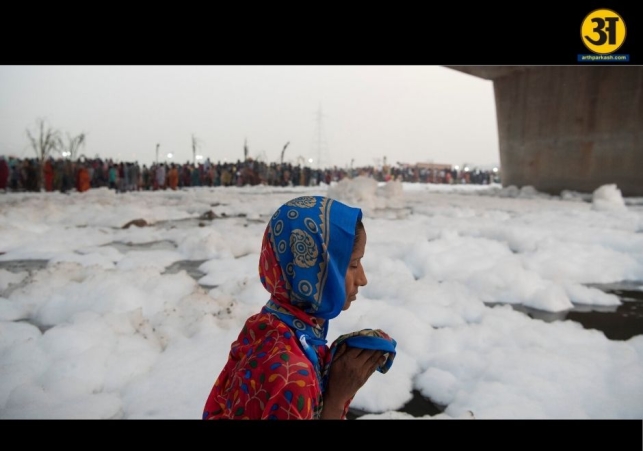
Chhath Puja holds immense emotional and spiritual value for millions of devotees, especially those from Bihar, Jharkhand, and eastern Uttar Pradesh. For them, the Yamuna’s banks in Delhi serve as a sacred space to offer prayers to the Sun God. But the condition of the river often turns these religious gatherings into a health hazard.
Every year, the government sets up temporary ghats (bathing areas) along the Yamuna for devotees. This year too, sanitation drives were conducted, and several ghats were cleaned before the festival. Still, environmental groups warn that contact with the water remains risky due to the high pollution levels.
According to experts, the presence of untreated sewage increases harmful bacteria in the river, while chemical waste from industries further worsens the situation. The foam that appears on the Yamuna’s surface — often seen during winters — is caused by high phosphate content from detergents and industrial discharges.
Despite years of promises, the overall progress in cleaning the Yamuna has been slow. The river receives about 3,800 million litres of wastewater daily, out of which nearly 2,000 million litres remain untreated. Until this untreated sewage is stopped, environmentalists say, the dream of a clean Yamuna will remain far away.
A river of devotion, still in distress
As Chhath Puja rituals begin, thousands of devotees will stand in the same waters that remain scientifically unsafe but spiritually pure for them. The contrast between faith and pollution reflects Delhi’s larger struggle — to balance tradition with environmental responsibility.
While the government claims progress and opposition parties trade blame, the Yamuna continues to carry the weight of both politics and pollution. Cleaner upstream but toxic within Delhi, the river still waits for a day when faith and cleanliness can flow together.
Related News